Blog

  • How to Build a Cashflow Dashboard from CRM, Invoicing & Accounting Data in Pretoria

    How to Build a Cashflow Dashboard from CRM, Invoicing & Accounting Data in Pretoria

    Most small firms lose time and cash when money data is messy. A cashflow dashboard fixes that.

    Direct answer (featured snippet): To build a cashflow dashboard, pick the cash KPIs you need (cash balance, cash in/out, runway, AR/AP). Connect CRM, invoicing, payments, bank, and accounting. Clean and standardise fields. Set simple forecast rules (terms + delays). Automate updates in Income Mavericks. Reconcile weekly so you trust the numbers.

    To build a cashflow dashboard, you pick the right cash metrics, connect CRM, invoicing, payments, banking, and accounting, clean the data, then automate updates in Income Mavericks. The goal is simple: see cash now and cash next.

    ![Build a cashflow dashboard showing cash in, cash out, runway, and receivables](MEDIA PLACEHOLDER 1: AI image | Minimalist | 1200×630 | Alt text: "Build a cashflow dashboard showing cash in, cash out, runway, and receivables" | Placement: Feature image at top)

    Direct answer: To build a cashflow dashboard, decide who it is for, choose cash KPIs (cash balance, cash in/out, runway, AR/AP), connect your systems, standardise fields, set forecast rules, automate syncs, and reconcile weekly.

    Table of Contents

    1. Define what your cashflow dashboard must show (and who it’s for)

    A dashboard is not a report. It helps you decide. So it must answer real questions.

    When you build a cashflow dashboard, start with the user. Then pick the numbers.

    Owner vs finance vs sales: different questions, different views

    One view cannot fit everyone. A good cashflow dashboard has clear views.

    Owner view (fast, simple):

    • How much cash is in the bank today?
    • How many weeks of runway are left?
    • What is the next cash gap risk?
    • What changed since last week?

    Finance view (detail and control):

    • What is overdue and why?
    • What needs follow-up today?
    • Are invoices, payments and VAT correct?
    • Do the numbers match the bank and the books?

    Sales view (pipeline to cash):

    • What deals may close soon?
    • When will cash land, not just when deals close?
    • What is blocked (quote, contract, invoice, payment link)?

    A simple rule: each view should fit on one screen.

    Core metrics: cash in/out, runway, AR/AP, profit vs cash

    A cashflow dashboard must show cash truth, not only profit.

    Include these core metrics:

    • Cash in (payments received)
    • Cash out (bank payments, debit orders, card spend)
    • Net cashflow (cash in minus cash out)
    • Cash balance (bank balance, by account if needed)
    • Runway (how long cash will last at current burn)
    • Accounts receivable (AR) (money owed to the business)
    • Accounts payable (AP) (money the business owes)
    • Profit vs cash (why profit is not cash)

    Also add a few drivers:

    • Top 5 customers by AR
    • Overdue invoices count and value
    • Failed payments count
    • Refunds and disputes count

    These make it easier to build a cashflow dashboard that leads to action.

    Decide your time horizons: daily, weekly, 13-week, monthly

    Different views stop different problems.

    Use these horizons:

    • Daily: cash balance, today’s collections, today’s payments
    • Weekly: collections plan, payroll week, key bills
    • 13-week: a strong planning window for most owners
    • Monthly: trend, seasonality, targets

    Keep it simple: start with weekly and 13-week. Add daily later.

    Direct CTA: If Blog Engine 2 [Test] wants to build a cashflow dashboard in Pretoria or across , start with the owner view first. Call +27 12 345 6789 or email info@example.com.

    2. Map your data sources: CRM, invoicing, payments, banking and accounting

    A cashflow dashboard is only as good as the data. First, map where each truth lives.

    If you want to build a cashflow dashboard that people trust, you must know which system owns what.

    Which system is the source of truth for customers and deals?

    Pick one system to own each key item:

    • Customers and contacts
    • Deals and pipeline stages
    • Products or services
    • Invoices
    • Payments
    • Bank transactions
    • Accounting entries

    In many setups:

    • CRM owns customers, deals and expected close dates
    • Invoicing system owns invoice status and due dates
    • Payment gateway owns payment events (paid, failed, refunded)
    • Bank feed shows what hit the account
    • Accounting system owns the final coded truth

    The dashboard should not fight this. It should connect it.

    Invoice and payment states that matter for cashflow timing

    Cash timing depends on states. Define them.

    Invoice states to track:

    • Draft
    • Sent
    • Due
    • Overdue
    • Paid
    • Written off
    • Credited

    Payment states to track:

    • Pending
    • Successful
    • Failed
    • Partial
    • Refunded
    • Disputed

    For forecasting, remember: an invoice sent is not cash. Cash is cash only when paid.

    Accounting structure essentials: chart of accounts, tracking categories, VAT

    For South Africa, VAT accuracy matters.

    Set these essentials before you build a cashflow dashboard:

    • A clean chart of accounts (income, cost, overheads)
    • Clear tracking categories (branch, service line, team, or region)
    • Consistent VAT setup (standard-rated, zero-rated, exempt)
    • Clear handling for discounts and credit notes

    If VAT codes differ across systems, the dashboard will drift. Then choices will be wrong.

    3. Standardise your data so it reconciles cleanly across systems

    This is the step most teams skip. Then the cashflow dashboard breaks.

    To build a cashflow dashboard that stays right, make the data match across tools.

    Customer and company naming conventions (de-duplication rules)

    Duplicates ruin dashboards. Set rules.

    Use simple naming rules:

    • One company name format (no random punctuation)
    • One legal name field, one trading name field
    • One primary email per contact
    • One customer ID that flows across systems

    De-duplication rules that help:

    • Match by email first
    • Match by VAT number for businesses
    • If names match but emails differ, flag for review

    Also decide: who may create customers? Keep it tight.

    Product/service categories aligned to reporting needs

    A cashflow dashboard needs useful groups. Not too many.

    Create a short list:

    • Recurring services
    • One-off projects
    • Setup fees
    • Support and maintenance
    • Expenses recharged

    Then ensure:

    • CRM uses the same categories
    • Invoices use the same categories
    • Accounting maps them to the right accounts

    This makes it easy to track:

    • Recurring vs one-off cash
    • Margin pressure areas
    • Seasonality by service line

    Dates, currencies, tax and discounts: common pitfalls to normalise

    Small date errors can cause big cash mistakes.

    Normalise these fields:

    • Invoice date
    • Due date
    • Paid date
    • Expected close date
    • Subscription billing date

    Then handle common pitfalls:

    • VAT inclusive vs VAT exclusive totals mixed up
    • Discounts applied before VAT in one system, after VAT in another
    • Partial payments without proper allocation
    • Refunds without links to the original invoice

    A simple policy helps: every payment must link to an invoice or a clear reason.

    4. Design your cashflow model: rules for forecasting and actuals

    A dashboard needs rules. Without rules, it is just numbers.

    When you build a cashflow dashboard, write the rules down. Then keep them the same.

    Cashflow definitions: accrual vs cash basis (and when to use each)

    There are two ways to view money.

    Cash basis:

    • Shows money when it moves
    • Best for daily choices
    • Best for runway

    Accrual basis:

    • Shows income when earned
    • Best for performance tracking
    • Best for month-end reporting

    For most owners: lead with cash basis, then add accrual as a second tab.

    Forecast logic from CRM: probability, stage weighting and expected close dates

    build a cashflow dashboard - A professional, clear image that illustrates build a cashflow dashboard: How to

    Forecasting needs a clear method.

    A simple method:

    • Each stage has a probability
    • Each deal has an expected close date
    • Cash timing uses expected invoice date plus payment terms

    Example stage weights (edit to fit the business):

    • New lead: low
    • Qualified: medium
    • Proposal sent: higher
    • Verbal yes: high
    • Won: 100%

    Rules to keep it real:

    • No close date means no forecast
    • No value means no forecast
    • If a deal sits too long, it drops in probability

    Cash collection logic: payment terms, typical delays and churn/refunds

    Forecasting must match real pay habits.

    Set these rules:

    • Standard payment terms (for example, due on receipt, 7 days, 30 days)
    • Typical delay by customer type (some always pay late)
    • Subscription churn rate assumptions (keep conservative)
    • Refund and dispute behaviour (track trends)

    Use ranges:

    • Best case
    • Expected
    • Worst case

    Income Mavericks can show these as scenario toggles in the cashflow dashboard.

    ![Cashflow dashboard model flow from CRM pipeline to invoices, payments, bank, and accounting](MEDIA PLACEHOLDER 2: AI image | Minimalist | 1200×630 | Alt text: "Cashflow dashboard model flow from CRM pipeline to invoices, payments, bank, and accounting" | Placement: After Section 4 before Section 5)

    5. Build the integration workflow (automate data collection end-to-end)

    This is where manual admin fades. The aim is one flow, end-to-end.

    To build a cashflow dashboard that updates on its own, you need clean triggers, syncs, and checks.

    Step 1: Lock the trigger points and owners

    First, define what event starts each action.

    Common triggers:

    • Deal marked Won
    • New subscription started
    • Invoice marked Sent
    • Payment marked Successful
    • Payment marked Failed

    Assign owners:

    • Sales owns deal data quality
    • Finance owns invoice and VAT accuracy
    • Ops owns fulfilment start dates

    Important: If nobody owns data quality, automation will spread bad data fast.

    Step 2: Automated invoice creation from won deals and subscriptions

    A clean rule is:

    • When a deal is Won, create an invoice draft
    • Pull customer details from CRM
    • Pull line items from the deal
    • Set due date from payment terms
    • Apply VAT codes based on product/service

    For subscriptions:

    • Create invoices on a schedule
    • Send invoice and payment link automatically
    • Update status in CRM

    This removes a big gap: sales-to-invoice delay.

    Step 3: Payments to receipts: getting reconciliation-ready transactions

    Payments must become accounting-ready records.

    The workflow should:

    • Capture payment ID, method, and time
    • Link payment to invoice
    • Create a receipt record
    • Mark the invoice as paid (or part-paid)
    • Log fees clearly (do not hide them)

    This enables:

    • Fast bank matching
    • Reliable cash-in numbers
    • Clean AR reports

    Step 4: Sync schedules, webhooks and error handling (what breaks first)

    Most breaks happen in three places:

    • Duplicate customer records
    • Failed webhooks or missed syncs
    • Changes to fields (a renamed field breaks mapping)

    Set up:

    • Near real-time updates for payments
    • Daily sync for accounting summaries
    • Clear error alerts to a shared inbox

    Minimum error handling:

    • Retry failed syncs
    • Log errors with reason
    • Flag records that need review

    Direct CTA: Want to build a cashflow dashboard inside Income Mavericks for Blog Engine 2 [Test]? Call +27 12 345 6789 or email info@example.com. Ask for a dashboard build plan for Pretoria and .

    6. Create the dashboard: layout, views and KPIs that drive decisions

    Dashboards must be simple. Each section must tell the user what to do next.

    When you build a cashflow dashboard, aim for clear blocks and clear actions.

    The executive overview: runway, net cashflow, top drivers

    The first screen should answer:

    • How much cash is there?
    • Is cash going up or down?
    • What will happen in the next 13 weeks?

    Include these widgets:

    • Current cash balance
    • Net cashflow this week
    • Runway (weeks)
    • Next cash gap date (if forecast shows a dip)
    • Top 3 cash-out categories
    • Top 3 expected collections (next 7 and 30 days)

    Also include a short notes panel:

    • What changed since last review
    • One action list (3 items max)

    Receivables view: overdue, upcoming collections, DSO and risk flags

    Receivables is where cash gets stuck.

    Include:

    • Overdue totals by ageing bucket
    • Upcoming due invoices (next 7 and 14 days)
    • Top overdue customers
    • DSO (days sales outstanding)

    Add risk flags:

    • Invoices with no sent date
    • Invoices sent but no view/open event (if tracked)
    • Repeat late payers
    • Partial payments not allocated

    Keep it actionable:

    • A short call list for finance
    • Next best action per account (resend, call, payment plan)

    Revenue should link to cash.

    Include:

    • Pipeline value by stage
    • Forecast cash-in by week (expected case)
    • Recurring cash-in trend
    • One-off cash-in trend

    If the business uses cohorts (like month started):

    • Cohort retention by month
    • Cohort churn signals
    • Upgrades vs downgrades

    Important: Keep charts easy to read. Use fewer colours.

    7. Validate and reconcile: trust the numbers before you act on them

    A dashboard is useless if people do not trust it.

    If you build a cashflow dashboard, plan time for checks. This keeps it true.

    Reconciliation checks between bank, payments and accounting

    Use simple checks. Do them weekly.

    Checks to run:

    • Bank deposits match payment receipts
    • Payment receipts match paid invoices
    • Paid invoices match accounting income
    • Fees are coded correctly

    A good rule:

    • The dashboard’s cash balance should match the bank feed.

    Spotting duplicates, missing invoices, misapplied payments and VAT issues

    Common issues and how to spot them:

    • Duplicate customers: same email, different names
    • Missing invoices: payment exists but no invoice link
    • Misapplied payments: payment linked to wrong invoice
    • VAT issues: wrong VAT code, or VAT totals do not match invoice rules

    Add a “data health” panel:

    • Duplicate customer count
    • Unlinked payments count
    • Invoices without due dates count
    • VAT exception count

    A weekly close routine: who does what and when

    A light close keeps dashboards clean.

    Weekly close checklist:

    1. Finance reviews failed payments and retries
    2. Finance matches bank to receipts
    3. Finance checks overdue list and follows up
    4. Sales updates close dates and deal values
    5. Owner reviews runway and next 13 weeks

    Keep it short. Thirty minutes beats three hours later.

    8. Operationalise it: alerts, review cadence and ownership

    build a cashflow dashboard - A professional, clear image that illustrates build a cashflow dashboard: How to

    Dashboards must create habits. Habits create results.

    When you build a cashflow dashboard, add alerts and a simple meeting rhythm.

    Threshold alerts: low runway, overdue spikes, cash gaps, failed payments

    Set alerts inside Income Mavericks so the team acts fast.

    Useful alerts:

    • Runway drops below a set number of weeks
    • Overdue invoices jump week-on-week
    • A big customer payment fails
    • A forecast cash gap appears in the next 30 days
    • Refunds and disputes spike

    Alerts should go to roles, not one person.

    Weekly cash meeting agenda (20 minutes) and monthly deep dive

    A short weekly meeting keeps cash calm.

    Weekly agenda (20 minutes):

    • Current cash balance and net cashflow
    • Top overdue items and next actions
    • Next 2 weeks: biggest inflows and outflows
    • Risks: failed payments, disputes, large bills
    • One decision to remove a bottleneck

    Monthly deep dive:

    • Trend review
    • Forecast accuracy review
    • AR ageing movement
    • Expense drift

    Access control and audit trail: keeping finance data safe

    Finance data is sensitive.

    Set rules:

    • Owners: full view
    • Finance: full view and edits
    • Sales: pipeline and forecast only
    • Ops: limited view

    Also keep an audit trail:

    • Who changed customer details
    • Who edited invoice amounts
    • Who updated payment terms

    9. Scale and improve: from dashboard to predictable revenue and higher EBITDA

    Once the dashboard works, it becomes a growth tool.

    If you build a cashflow dashboard the right way, you can speed up cash and cut waste.

    Identify bottlenecks: sales-to-invoice, invoice-to-cash, refunds and disputes

    Use the dashboard to find where cash slows down.

    Common bottlenecks:

    • Deals won but not invoiced
    • Invoices sent late
    • Many invoices overdue in the same segment
    • Too many payment failures
    • High refunds in one service line

    Each bottleneck gets a fix:

    • Auto-create invoices
    • Add payment links
    • Add reminders
    • Tighten handoffs

    Improve conversion and collections with automation and clear handoffs

    Small automation changes can lift cash fast.

    Examples:

    • Auto-send invoice on “Won”
    • Auto-send reminders before due date
    • Auto-assign tasks to call late payers
    • Auto-tag customers who always pay late

    Clear handoffs:

    • Sales owns deal fields before “Won”
    • Finance owns terms and collections
    • Ops owns delivery start, so billing is on time

    What to automate next: budgeting, scenario planning and forecasting accuracy

    Once the data is clean, expand the system.

    Next automations:

    • Budget vs actual tracking
    • Scenario planning (what if a top customer churns?)
    • Forecast accuracy scoring by rep or channel
    • Cashflow drivers by service line

    This is how a cashflow dashboard helps:

    • More predictable revenue
    • Higher conversion rates
    • Less manual admin
    • Cleaner data and better decisions
    • Less owner burnout
    • Higher EBITDA and business value

    Key takeaways

    • To build a cashflow dashboard, start with the user and the questions.
    • Cash basis drives day-to-day choices. Add accrual as a second view.
    • Clean data matters more than fancy charts.
    • Link CRM pipeline to invoicing and payment timing.
    • Automate invoice creation and payment-to-receipt capture.
    • Reconcile weekly so the team trusts the numbers.
    • Use alerts and a short weekly cash meeting to stay ahead.

    FAQ

    How do you build a cashflow dashboard that owners will actually use?

    To build a cashflow dashboard owners use, keep it simple and action-led. Show cash balance, net cashflow, runway, and the next cash gap risk. Update it from CRM, invoicing, payments, and accounting. Add a short action list.

    What data is needed to build a cashflow dashboard?

    To build a cashflow dashboard, you need CRM deal data, invoice data, payment status data, bank transaction data, and accounting categories. Key fields include customer ID, invoice amount, due date, paid date, payment status, and VAT codes.

    How can a dashboard forecast cash from the sales pipeline?

    A cashflow dashboard can forecast cash by using deal stages, probability weights, and expected close dates. Then it applies rules for invoice timing and payment terms to estimate when cash will arrive. A good forecast also allows for late payments, churn, and refunds.

    How often should cashflow dashboards update?

    Payments should update close to real time, because cash changes fast. Invoices and CRM pipeline can update during the day. Accounting summaries often update daily. The key is steady updates and error alerts.

    Why don’t cashflow dashboards match profit reports?

    Profit reports often use accrual rules, which record income when earned. Cashflow dashboards track money when it moves in or out of the bank. Gaps come from unpaid invoices, credit notes, VAT timing, loan payments, and owner drawings.

    Direct CTA: If Blog Engine 2 [Test] wants to build a cashflow dashboard in Pretoria and cover , the next step is a data map and a simple 13-week model. Call +27 12 345 6789 or email info@example.com to book a dashboard planning session and get a quote.

    META DESCRIPTION: Build a cashflow dashboard that links CRM, invoices, payments, bank, and accounting. Track cash balance, runway, AR/AP, and 13-week forecasts in Pretoria.


  • How to Automate Invoices from Your CRM to Accounting in Pretoria

    How to Automate Invoices from CRM to Accounting in Pretoria (Automate invoices from CRM to accounting)

    To automate invoices from CRM to accounting, connect your CRM, accounting tool, and payments so data moves on its own. When a deal is won, an invoice is made and sent. When the customer pays, the invoice is marked paid and the CRM updates too. This cuts admin time, reduces errors, and keeps VAT and records clean.

    Many South African businesses still copy and paste data. That leads to missed invoices, wrong VAT, and messy customer info. This guide shows a simple quote-to-cash flow that works.

    CRM to accounting invoice automation flow: quote to invoice to payment to reconciliation

    Map the Quote-to-Cash Workflow (Before You Automate)

    Automation works best when the steps are clear. Start with a short map. Use simple words.

    Goal: every quote, invoice, and payment follows one path.

    Key steps to map:

    • Where a quote starts
    • When a deal becomes an invoice
    • How a customer pays
    • How the payment lands in accounting
    • How the CRM gets the final status

    Pick your trigger. This is the moment that starts the next step:

    • Quote accepted
    • Deal marked as won
    • Deposit paid

    Next, clean your invoice fields. If fields are messy, automation will copy the mess. If you want to automate invoices from CRM to accounting, fix the fields first.

    Fields to standardise:

    • Customer name and billing details
    • Email and phone
    • Line items with clear names
    • Quantity and unit price
    • Discounts and notes
    • VAT fields and VAT rules
    • Payment terms (due now, due in 7 days)

    Important: confirm how VAT must show on invoices. In South Africa, VAT rules matter. Wrong setup means wrong reports.

    Now decide what lives where. Each tool needs one job.

    A simple split:

    • CRM: leads, deals, stages, tasks
    • Accounting: invoices as legal records, VAT reporting, statements
    • Payments: payment links, card/EFT options, receipts

    If two tools both create invoices, you get duplicates. Pick one source of truth. This helps you automate invoices from CRM to accounting without errors.

    Choose the Right CRM–Accounting–Payments Integration Setup

    There are two common ways to connect tools when you automate invoices from CRM to accounting.

    Option 1: Native integrations

    • Fast to set up
    • Fewer parts
    • Best for simple flows

    Option 2: Middleware automation

    • More control
    • Better for custom rules
    • Best for deposits, stages, and custom fields

    Plan for real payment cases:

    • VAT and mixed VAT items
    • Discounts (per line or per invoice)
    • Deposits and part payments
    • Instalments and payment plans

    Also align customer matching and product names. This prevents duplicates and bad reports. It also makes it easier to automate invoices from CRM to accounting with clean data.

    Checks before you go live:

    • Invoice number format is set
    • Product/service names match
    • Customer matching rules are clear
    • One unique key is used (email or customer code)

    Important: decide what happens when customer details change. If the billing email changes, the systems must still match the same customer.

    Build Automation: Quotes → Invoices → Payments → Reconciliation-Ready Data

    Build in small steps. Do not do everything at once. This is the safest way to automate invoices from CRM to accounting.

    1. Set the trigger in the CRM

      • Use one event (like deal won)
      • Require key fields (billing email, VAT number if needed)
    2. Auto-create the invoice in accounting

      • Use an invoice template
      • Map CRM fields to invoice fields
      • Start with simple rules

      Simple rules to start:

      • If deal is won, create invoice
      • If deposit is needed, create deposit invoice only
    3. Send the invoice and sync status

      • Send from the accounting tool
      • Turn on overdue reminders
      • Keep email text short

      Sync these statuses back to the CRM:

      • Sent
      • Overdue
      • Paid
    4. Add payment links and receipts

      • Add a payment link to the invoice
      • Use the invoice number as the payment reference
      • Send an auto receipt after payment

      For deposits and part payments:

      • Decide if you use one invoice with payments applied
      • Or a deposit invoice plus a final invoice
      • Make sure the balance updates in both tools
    5. Make the data easy to reconcile

      • Match each payment to the right invoice
      • Handle fees the same way each time
      • Post income to the right account

    Important: the win is not only sending invoices. The win is clean data that reconciles fast. That is why teams automate invoices from CRM to accounting.

    Example invoice fields to map when you automate invoices from CRM to accounting

    Test, Monitor, and Improve Cash-Collection Performance

    Test with real cases, not perfect ones.

    Use this test list:

    • New customer
    • Existing customer
    • Wrong email on the deal
    • VAT on and VAT off items
    • Discount added
    • Part payment made
    • Payment failed then retried
    • Refund or credit note needed

    After week one, track simple numbers:

    • Days Sales Outstanding (DSO)
    • Overdue invoice rate
    • Time from sent to paid

    If results do not improve, check for common blocks:

    • Deals missing key fields
    • Invoices not sent on time
    • Reminders not firing
    • Payment links not used

    Keep basic control in place:

    • Clear user permissions
    • Audit trail for invoice changes
    • One owner for the process

    Important: automation is a system. A person must own it.

    Conclusion

    A clean quote-to-cash flow helps you get paid faster. It also keeps VAT and records tidy. To automate invoices from CRM to accounting, map the steps, pick one source of truth, connect your tools, and sync invoice and payment status.

    For help building a setup that fits the way the business sells in Pretoria and across Centurion, Midrand, Sandton, contact Blog Engine 2 [Test]. Call +27126549876 or email hello@blogengine2.techanisms.com to book an invoice automation review and get a clear next-step plan.


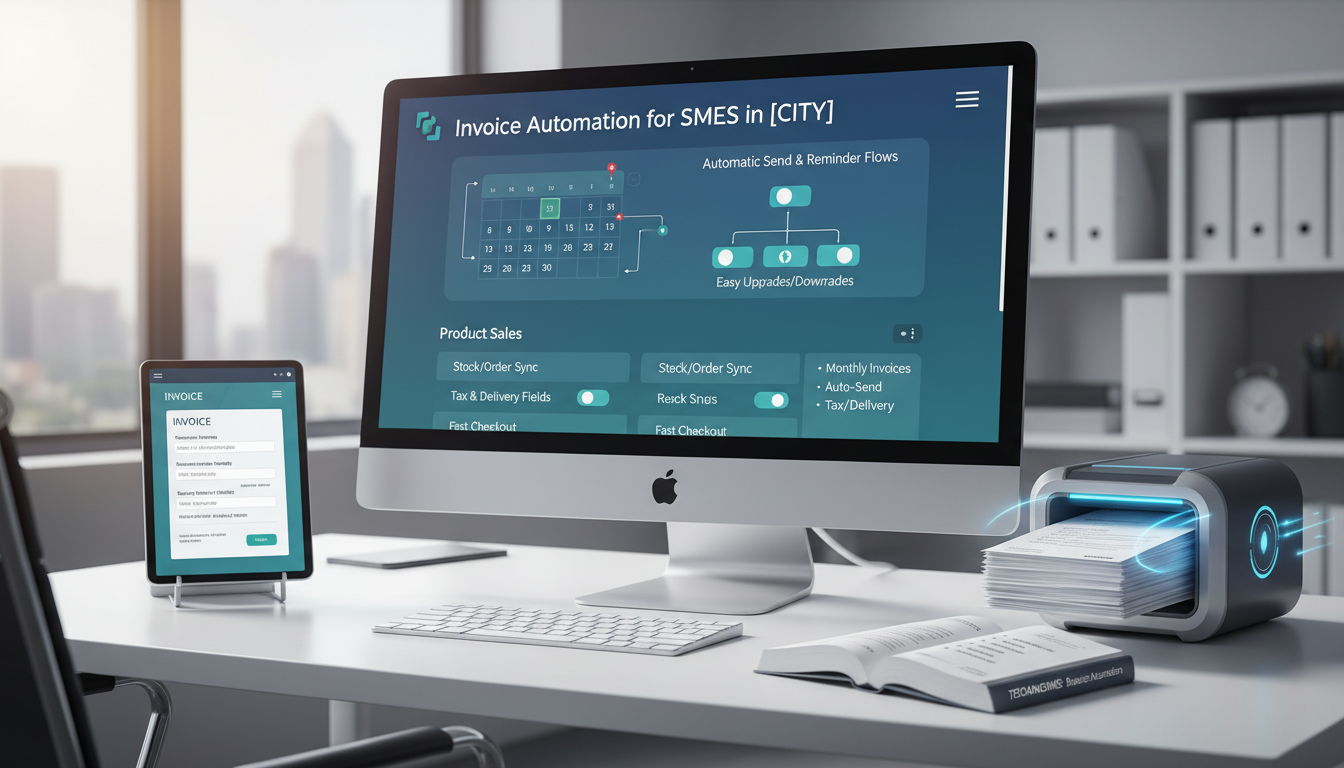
  • Invoice Automation for SMEs in Pretoria: Cut Admin, Speed Up Cash Flow

    Invoice Automation for SMEs in Pretoria: Cut Admin, Speed Up Cash Flow

    [[META DESCRIPTION: Invoice automation helps SMEs in Pretoria send invoices faster, cut admin time, reduce errors, and get paid sooner with simple workflows and controls.]]

    [[MEDIA: AI-GENERATED IMAGE | size: 1200×630 | style: Business automation (Techanisms), clean SaaS diagram look | placement: feature at top | alt: invoice automation workflow for SMEs showing CRM to invoice to payment to accounting sync]]

    Invoice automation is a simple way to create, send, track, and record invoices with less manual work. It connects your sales data, invoice tool, payments, and accounting.

    Direct answer (featured snippet): Invoice automation uses rules and connected tools to turn “work done” into “invoice sent,” then “payment matched,” then “books updated.” It creates invoices from your sales or job data, sends them with payment options, follows up with reminders, and syncs results to accounting. This cuts admin time, errors, and late payments.

    A Pretoria business owner once said their week had two peaks. One was sales. The other was admin. Deals came in. Then late nights started. Invoices sat in drafts. Payments arrived with no reference. Month-end felt like a rescue mission.

    Invoice automation flips that story. It turns invoicing into a calm, repeatable flow. It cuts chaos. It improves cash flow visibility. And it keeps data tidy for better decisions.

    Direct answer: Invoice automation is a set of rules and tool links that move you from “work done” to “invoice sent” to “payment matched” to “books updated” with fewer clicks and fewer mistakes.

    [[MEDIA: AI-GENERATED IMAGE | size: 1200×700 | style: Simple checklist infographic, clean SaaS look | placement: after intro | alt: invoice automation checklist for SMEs showing trigger, invoice draft, approval, send with payment link, reminders, accounting sync]]

    Table of Contents

    What invoice automation actually is (and what it isn’t)

    Invoice automation is not just emailing a PDF. It is not only a nice template. It is a full workflow.

    It helps a business move from: job done → invoice sent → payment collected → books updated.

    From manual invoicing to automated workflows

    Manual invoicing often looks like this:

    • Someone copies details from a quote
    • Someone checks VAT and totals
    • Someone emails an invoice
    • Someone follows up when it is late
    • Someone matches payments to invoices
    • Someone fixes errors at month-end

    Invoice automation replaces repeat steps with rules. People still stay in control. But the system does more of the work.

    The goal is simple: less admin, fewer mistakes, faster cash in.

    Most good invoice automation setups include:

    • Triggers: a rule that starts invoicing (example: deal marked Won)
    • Templates: invoice layouts with the right fields and VAT notes
    • Approvals: checks before sending (example: margin or discount review)
    • Payment links: pay-now options inside the invoice
    • Sync: updates across CRM, accounting, and payment tools

    When these parts work together, invoice automation becomes predictable.

    Common myths that hold SMEs back

    Many SMEs delay invoice automation due to myths like:

    • Myth: automation is only for big firms
      Truth: SMEs often gain the most, because time is tight.
    • Myth: it removes control
      Truth: good setups add checks, approvals, and audit trails.
    • Myth: it is too complex
      Truth: the best flows are simple and use fewer steps.
    • Myth: it will break VAT or compliance
      Truth: the right rules make VAT handling more consistent.

    Why SMEs in Pretoria are automating invoicing now

    SMEs in Pretoria face the same pressure each month: do more with less. Cash must move. Admin must shrink. Data must be trusted.

    Cutting admin time without adding headcount

    Invoice automation reduces repeat work like:

    • Copying client details
    • Rebuilding line items
    • Checking totals
    • Sending reminder emails
    • Updating invoice status by hand

    This frees people up for higher value work.

    Result: a smaller admin load without hiring.

    Getting paid faster and improving cash flow visibility

    Late invoicing leads to late payment. It is that simple.

    Invoice automation helps by:

    • Sending invoices as soon as work is approved
    • Adding clear payment terms and due dates
    • Including pay-now links
    • Sending polite reminders on schedule

    It also helps teams see what is happening right now:

    • What is sent
    • What is overdue
    • What is paid
    • What is stuck in approval

    This supports better choices on spending and growth.

    Reducing errors, disputes, and messy data

    Disputes often start with small mistakes:

    • Wrong client details
    • Wrong VAT treatment
    • Missing purchase order numbers
    • Different wording across invoices

    Invoice automation helps you keep inputs the same each time. It also logs what changed and when.

    Cleaner data means:

    • Fewer back-and-forth emails
    • Faster month-end close
    • Better reporting and dashboards

    The end-to-end invoice automation workflow (step-by-step)

    This is a practical flow most SMEs can use. It can start in a CRM, a job system, or a sales pipeline.

    [[MEDIA: AI-GENERATED IMAGE | size: 1200×700 | style: Clean flowchart diagram, simple SaaS look | placement: before Step 1 | alt: step-by-step invoice automation workflow from quote approval to invoice send to reminders to payment matching to accounting sync]]

    Step 1: Quote/Order to invoice creation

    The first win is to stop retyping.

    A strong setup does this:

    1. Quote or order is approved
    2. The system creates a draft invoice
    3. Client details pull in from the CRM
    4. Line items pull in from the quote
    5. VAT rules apply based on the product and client

    Key rule: one source of truth. Client records should live in one main place.

    Helpful fields to capture early:

    • Legal entity name
    • VAT number (if relevant)
    • Billing email
    • Billing address
    • Purchase order requirement
    • Payment terms

    Step 2: Approval and control checks

    Not every invoice needs approval. But some should.

    Common approval triggers:

    • Discount above a set rule
    • Invoice value above a set rule
    • New client (first invoice)
    • Manual line item edits

    Controls to add:

    • Required fields must be filled
    • VAT calculation must match rules
    • Invoice number must be unique

    Best practice: keep approvals fast. If it takes days, cash slows down.

    Step 3: Sending invoices with the right payment options

    Once approved, invoices should send from a shared system.

    Good sending includes:

    • A clear subject line
    • A due date in plain words
    • A short payment instruction
    • A pay-now link where possible

    Payment options in South Africa often include:

    • Card payments via a payment gateway
    • Bank transfer (EFT)
    • Direct Debit where suitable

    Make it easy to pay. More steps can mean slower payment.

    Step 4: Automated reminders and status updates

    Follow-up should not rely on memory.

    A simple reminder plan:

    • Reminder before due date
    • Reminder on due date
    • Reminder after due date
    • Escalation if still unpaid

    Status updates to automate:

    • Sent
    • Viewed (if supported)
    • Paid
    • Overdue
    • In dispute

    Internal alerts can help too:

    • Notify account manager when an invoice goes overdue
    • Notify finance when a payment arrives with no reference

    Step 5: Reconciliation-ready accounting entries

    This is where many SMEs feel the pain.

    A good workflow makes accounting easier by:

    • Posting invoices to the right accounts
    • Recording VAT correctly
    • Linking payments to the right invoices
    • Creating receipts automatically when payment is confirmed

    Goal: when the bank feed shows a payment, matching should be fast.

    Outputs to aim for:

    • Clean debtor ledger
    • Accurate VAT reporting
    • Consistent chart of accounts coding
    • Fewer suspense items

    Integrations that make invoice automation work (CRM, accounting, payments)

    Invoice automation works best when systems talk to each other. Keep the integration map simple.

    CRM triggers: when an invoice should be created

    A CRM can start the workflow when:

    • A deal is marked Won
    • A job is marked Complete
    • A project milestone is approved
    • A subscription renews

    Rules to define:

    • Who can trigger invoice creation
    • What fields must exist before an invoice can be created
    • What happens if a deal is changed after invoicing

    Tip: lock key fields after send. This helps stop silent changes.

    Accounting sync: chart of accounts, VAT, and tracking categories

    Accounting sync should handle:

    • Customer records
    • Invoice numbers
    • VAT treatment and notes
    • Revenue accounts
    • Tracking categories (like branch, team, service line)

    For South Africa, VAT handling should be consistent and easy to check.

    Data rules to agree on:

    • One chart of accounts structure
    • One naming standard for customers
    • One way to handle credit notes and adjustments

    Payment integrations: cards, bank transfer, Direct Debit, and receipts

    Payments should update invoice status with minimal manual steps.

    A strong payment setup can:

    • Add a pay-now link to invoices
    • Confirm payments automatically
    • Create receipts
    • Mark invoices as paid
    • Push payment data into accounting

    Watch references. Bank transfers often arrive with weak notes. A good setup helps match them.

    Notifications: email, SMS, and internal alerts

    Notifications keep work moving.

    Consider:

    • Email to client for invoice and reminders
    • SMS for short overdue nudges (where it fits the brand)
    • Internal alerts for exceptions

    Exceptions to flag:

    • Invoice bounced
    • Client says they did not receive it
    • Payment came in but did not match
    • Invoice is overdue past a set point

    Choosing the right invoice automation setup for your business model

    There is no one “best tool”. The best setup matches the way a business sells.

    Project-based services vs retainers vs product sales

    Project-based services often need:

    • Milestone invoicing
    • Time or deliverable based line items
    • Strong approvals
    • Purchase order fields

    Retainers often need:

    • Monthly recurring invoices
    • Automatic send on set dates
    • Simple reminder flows
    • Easy upgrades and downgrades

    Product sales often need:

    • Stock or order sync
    • Tax and delivery fields
    • Faster invoice creation at checkout

    Choose the workflow first. Then choose the tools.

    One-off invoices vs subscriptions and recurring billing

    invoice automation - A professional, clear image that illustrates invoice automation: Invoice Automat

    One-off invoicing needs:

    • Fast creation
    • Clear approvals
    • Strong reminders

    Recurring billing needs:

    • A reliable schedule
    • Rules for proration and changes
    • Clear renewal and cancellation handling

    If recurring billing is used, define:

    • What happens when a payment fails
    • How retries work
    • When to stop service or escalate

    Multi-entity, multi-currency, and complex pricing considerations

    Some SMEs in have more complexity, such as:

    • More than one legal entity
    • Different business units
    • Cross-entity billing
    • Multi-currency invoicing

    Key choices to make early:

    • Which entity issues which invoice
    • How invoice numbers are managed per entity
    • How reporting will roll up

    For complex pricing, avoid hard-coding logic in many places. Keep pricing rules in one system where possible.

    Controls and compliance: keeping automated invoicing accurate and audit-friendly

    Invoice automation should make finance stronger, not riskier.

    VAT handling, invoice numbering, and data quality rules

    Controls to set up:

    • VAT rules by product and client type
    • Invoice numbering that is unique and sequential per entity
    • Required fields before send (billing email, VAT number when needed)
    • Locked invoices after sending, with change control

    Also define a standard for:

    • Credit notes
    • Write-offs
    • Partial payments

    Data quality is a control. Bad inputs create bad outputs.

    Permissions, approvals, and segregation of duties

    Even small teams need simple separation.

    Examples:

    • Sales can create drafts
    • Finance approves and sends
    • Owners approve large discounts

    Permission rules to consider:

    • Who can edit customer bank details
    • Who can delete drafts
    • Who can issue credit notes

    Keep an audit trail:

    • Who changed what
    • When it changed
    • Why it changed

    Avoiding duplicate invoices and reconciliation mismatches

    Duplicates happen when:

    • A deal is triggered twice
    • Staff resend a draft as a new invoice
    • The CRM and accounting both create invoices

    Prevention steps:

    • Use one system as the invoice “owner”
    • Use unique IDs between systems
    • Block duplicate triggers
    • Reconcile daily or weekly, not only month-end

    If it cannot be matched, it will become a month-end problem.

    Implementation plan: how to roll out invoice automation in 30–60 days

    This rollout plan is built for SMEs. It aims for quick wins and low risk.

    Process mapping: where delays and errors start

    Before building anything, map the current flow.

    Ask:

    • Where does invoicing start today?
    • Where does it stall?
    • Where do mistakes happen?
    • Who owns each step?

    Write down:

    • Trigger points
    • Systems involved
    • Approval steps
    • Exceptions

    Keep it simple. One page is enough.

    Data cleanup and template standardisation

    Invoice automation needs clean inputs.

    Clean up:

    • Duplicate customers
    • Missing emails
    • Wrong VAT numbers
    • Old addresses
    • Unclear payment terms

    Standardise templates:

    • One invoice layout per entity or brand
    • Clear payment instructions
    • Consistent line item names
    • Clear VAT notes where needed

    If templates vary too much, reporting will suffer.

    Pilot, test cases, and edge scenarios

    Start with a pilot group.

    Pick:

    • One service line
    • A small set of customers
    • A few invoice types

    Test cases to run:

    • Normal invoice
    • Discount approval
    • Partial payment
    • Overpayment
    • Credit note
    • Payment with no reference

    Edge scenarios to include:

    • Customer requires a purchase order
    • Two contacts need the invoice
    • Split billing across departments

    Do not skip testing. It is cheaper than fixing live errors.

    Team training and handover to avoid ‘automation abandonment’

    Automation fails when people stop using it.

    Training should cover:

    • What changed and why
    • Where to start the process
    • What to do when something breaks
    • Who to ask for help

    Handover pack should include:

    • A one-page process guide
    • A list of rules and triggers
    • An exception playbook
    • Access and permission notes

    Assign an owner. If no one owns it, it drifts.

    Common pitfalls (and how to avoid them)

    These issues show up in most projects. They are avoidable.

    Automating a broken process

    If the process is unclear, automation will speed up confusion.

    Fix first:

    • Who approves what
    • When an invoice should go out
    • What fields are required

    Then automate.

    Overcomplicating with too many tools

    Too many tools mean:

    • More logins
    • More syncing issues
    • More support risk

    Aim for:

    • One CRM trigger
    • One accounting system of record
    • One payment link method
    • One place for reporting

    If a tool does not add clear value, remove it.

    Ignoring reporting needs until month-end

    If reporting is not planned, teams will scramble later.

    Define early:

    • What finance needs weekly
    • What owners need monthly
    • What sales needs daily

    Examples of useful views:

    • Overdue invoices by account manager
    • Cash collected this week
    • Invoices stuck in approval
    • Reasons for disputes

    Not defining ownership and exception handling

    Automation needs a human backstop.

    Define:

    • Who handles disputes
    • Who handles failed payments
    • Who fixes data issues
    • Who changes templates

    Also define response times. Even simple SLAs help.

    What success looks like: metrics to track and next automations to add

    Success is not “we turned on a tool”. Success is better outcomes.

    Key KPIs: time-to-invoice, debtor days, collection rate, error rate

    Track a small set of clear metrics:

    • Time-to-invoice: job done to invoice sent
    • Debtor days: how long payment takes
    • Collection rate: paid vs billed in a set period
    • Error rate: credit notes and reissued invoices
    • Dispute rate: invoices flagged by customers

    Also track:

    • Invoices sent on time
    • Invoices stuck in approval
    • Payments unmatched

    Keep metrics visible. A simple dashboard works.

    Cash flow reporting and finance dashboards for better decisions

    With clean data, dashboards become useful.

    Dashboards can show:

    • Cash in vs cash out trend
    • Overdue risk
    • Top customers by outstanding balance
    • Revenue by service line

    This supports better planning and reduces owner stress.

    Next steps: purchase order automation, expense capture, revenue recognition

    Once invoicing is stable, add the next layer.

    Good next automations:

    • Purchase order capture and approval
    • Expense capture with rules
    • Automated bank matching
    • Revenue recognition rules (where needed)

    Do not add everything at once. Build trust step by step.

    Key Takeaways

    • Invoice automation links invoicing, payments, and accounting into one flow.
    • It helps SMEs cut admin, reduce errors, and improve cash collection.
    • The best setups use clear triggers, templates, approvals, payment links, and sync.
    • Controls matter: VAT rules, permissions, and audit trails keep it safe.
    • A 30–60 day rollout works best with mapping, cleanup, a pilot, and training.
    • Track success with time-to-invoice, debtor days, and error rate.

    Conclusion

    Invoice automation is a fast way for SMEs in Pretoria to cut admin and get paid faster. It creates a repeatable process. It improves data quality. And it gives owners clearer cash flow visibility.

    For a practical next step, Blog Engine 2 [Test] can help map the current invoicing process, pick the right integrations, and roll out a simple workflow that your team will actually use.

    Call +27 12 345 6789 or email info@example.com to book an invoice automation setup call. Or visit to request a workflow review for .


  • Retention Campaign Metrics in Pretoria: Dashboards & KPIs to Stop Leaks

    Retention Campaign Metrics in Pretoria: Dashboards & KPIs to Stop Leaks

    Retention campaign metrics are the numbers that show if WhatsApp, SMS, and email messages are bringing customers back and keeping them loyal. They track who returns, who buys again, and where people drop off. With the right dashboard, Blog Engine 2 [Test] can spot revenue leaks fast and fix them before they grow.

    [IMAGE: Feature image | Style: clean B2B automation visual | Size: 1200×630 | Alt text must include: retention campaign metrics | Suggested alt: "Retention campaign metrics dashboard showing WhatsApp, SMS and email performance"]

    In Pretoria and across , many teams send messages but do not measure what matters. The result is guesswork, messy data, and slow growth. This master guide gives a clear, simple way to pick KPIs, build dashboards, and turn retention into predictable revenue.

    Table of Contents

    What to measure first (so the dashboard stays simple)

    Retention reporting fails when it tries to track everything. The goal is not more charts. The goal is clear actions.

    Start with three questions:

    1. Are customers seeing the message?
    2. Are they replying or clicking?
    3. Are they coming back and spending again?

    The three layers of retention campaign metrics

    Layer 1: Delivery health

    • If messages do not land, nothing else matters.

    Layer 2: Engagement

    • Shows if the message got attention.

    Layer 3: Business outcomes

    • Shows if it made money and reduced churn.

    The rule that keeps tracking clean

    Pick one main goal per campaign. Examples:

    • Reactivate old customers
    • Reduce no-shows
    • Drive repeat purchase
    • Move people to a membership or plan

    Then track:

    • 2 delivery metrics
    • 2 engagement metrics
    • 2 outcome metrics

    That is enough to run the business.

    The retention KPI set that most service businesses need

    This is a core KPI set that works for many local businesses in South Africa. It fits WhatsApp workflows, SMS reminders, and email sequences.

    Core outcome KPIs (the ones that matter most)

    • Reactivation rate: % of lapsed customers who return.
    • Repeat rate: % of customers who buy again.
    • Time to next purchase/booking: days between visits.
    • Retention revenue: revenue tied to retention campaigns.
    • Churn proxy: % who do not return in a set time.

    Core engagement KPIs (helps explain the outcome)

    • Reply rate (two-way channels)
    • Click rate (links to booking or offers)
    • Conversion rate: % who complete the next step

    Core delivery KPIs (protects performance)

    • Delivery rate: % delivered successfully
    • Bounce/failed rate: % that did not deliver

    The “speed” KPI that changes everything

    For two-way messaging, track:

    • First response time: how long it takes to reply.

    In many cases, faster replies mean more bookings.

    WhatsApp retention campaign metrics (two-way and fast)

    WhatsApp is often the best retention channel when customers want quick answers. It also works well for reminders, follow-ups, and reactivation.

    WhatsApp KPIs to track for retention

    Delivery and reach

    • Delivered: messages delivered to the phone.
    • Read rate (if available): messages opened.

    Two-way engagement

    • Reply rate: customers who respond.
    • Conversation started: chats opened from a broadcast.
    • Inbox backlog: open chats not yet handled.

    Outcome

    • Booked from WhatsApp: bookings made after chat.
    • Show-up rate: attended after reminders.
    • Reactivation wins: lapsed customers who return.

    A simple WhatsApp retention dashboard layout

    Keep it short. One screen.

    • Broadcast sent → delivered → replies → bookings
    • Median first response time
    • No-show rate after reminder flow

    Common WhatsApp revenue leaks (and the metric that exposes them)

    • Leak: messages go out, but nobody replies.
      • Watch: reply rate and offer clarity.
    • Leak: replies come in, but staff respond late.
      • Watch: first response time and backlog.
    • Leak: people ask questions, but do not book.
      • Watch: chat-to-booking conversion.

    SMS retention campaign metrics (short, sharp, reliable)

    SMS is simple and tough. It reaches almost everyone. It is great for reminders and quick reactivation nudges.

    SMS KPIs to track

    Delivery health

    • Delivery rate
    • Failed sends (often bad numbers)

    Engagement

    • Link click rate (if links are used)
    • Reply rate (if two-way SMS is enabled)

    Outcome

    • Bookings after SMS
    • No-show reduction after reminder series
    • Rebook rate after service follow-up

    Best-practice SMS reminder metric set

    For appointment-heavy businesses, track these per week:

    • Appointments reminded
    • Confirmations received
    • Cancellations captured early
    • No-show rate

    This shows if reminders reduce chaos and wasted time.

    Missed call text-back metrics (often ignored)

    If Blog Engine 2 [Test] uses a missed call text-back system, track:

    • Missed calls
    • Text-backs sent
    • Replies
    • Booked from missed call flow

    This turns lost calls into sales.

    Email retention campaign metrics (depth and value)

    Email is strong for longer follow-ups. It works well for education, loyalty, and repeat purchase. It also helps keep data tidy.

    Email KPIs that connect to retention

    Delivery

    • Deliverability rate
    • Bounce rate

    Engagement

    • Open rate (use as a hint, not the truth)
    • Click rate

    Outcome

    • Conversion rate: booked, bought, or renewed
    • Repeat revenue from email
    • Unsubscribe rate (a quality signal)

    The email metrics that stop silent churn

    Silent churn is when customers do not complain. They just vanish.

    Track:

    • Days since last purchase by segment
    • Reactivation conversions from win-back sequences
    • Repeat purchase rate for key services

    If these drop, the business is losing future revenue.

    The dashboards that stop revenue leaks (what to show weekly)

    retention campaign metrics - A professional, clear image that illustrates retention campaign metrics: Retenti

    Dashboards should help owners and managers decide fast. The best ones show movement, not noise.

    Dashboard 1: Retention performance (weekly)

    Goal: see if retention is growing.

    Show:

    • Reactivation rate
    • Repeat rate
    • Retention revenue
    • Time to next booking

    H3 tips to keep it readable:

    • Compare this week vs last week
    • Track a 4-week trend

    Dashboard 2: Channel performance (WhatsApp vs SMS vs email)

    Goal: know what works best.

    Show per channel:

    • Delivered
    • Replies/clicks
    • Conversions

    Then add one simple view:

    • Cost varies, but time cost is real. Track staff time spent per channel.

    Dashboard 3: Revenue leak finder (the funnel view)

    Goal: spot where people drop.

    A simple funnel:

    • Target list size
    • Delivered
    • Engaged (reply or click)
    • Booked/bought
    • Showed up

    If the funnel breaks, fix that step first.

    Dashboard 4: Operations impact (less chaos)

    Goal: prove automation reduces admin.

    Track:

    • Inbound message volume
    • Handled within SLA (set a target time)
    • Backlog at end of day
    • Cancellations captured early

    This protects the owner from burnout.

    How to track no-shows, cancellations, and repeat bookings

    In many service businesses, no-shows are a direct revenue leak. They also break schedules.

    No-show metrics that matter

    Track these weekly:

    • No-show rate (no-shows ÷ total bookings)
    • Late cancellation rate
    • Reschedule rate
    • Recovered slots (spots filled after a cancellation)

    Link metrics to the reminder flow

    To make metrics useful, connect them to the workflow.

    Example reminder flow:

    • 48 hours before: reminder
    • 24 hours before: confirm
    • Morning of: last check-in

    Then measure:

    • Confirmation rate per step
    • No-show rate by confirmed vs not confirmed

    This shows which message is doing the work.

    Repeat booking metrics (retention in plain terms)

    If the business wants higher repeat sales, track:

    • Rebook within X days (pick a time window that fits)
    • Average time between bookings
    • Top repeat services

    If repeat is low, the campaign is not strong enough.

    Data hygiene metrics (clean data = better decisions)

    Bad data ruins dashboards. It also wastes message spend and staff time.

    The minimum data hygiene KPIs

    Track:

    • Invalid mobile numbers (failed SMS)
    • WhatsApp opt-in status (where needed)
    • Email bounces
    • Duplicate contacts
    • Missing fields (name, last visit date, service type)

    Why this matters for retention campaigns

    If data is messy:

    • Customers get the wrong message.
    • Staff cannot see history.
    • Reports look better or worse than reality.

    That leads to bad decisions.

    Simple fixes that improve metrics fast

    • Add a mandatory mobile number check at capture.
    • Use a single source of truth for contacts.
    • Set rules for naming and tags.
    • Sync booking/CRM data into the messaging system.

    How to turn metrics into actions (a simple weekly routine)

    Metrics only help when they change behaviour. This routine works for lean teams.

    Step 1: Pick one focus leak per week

    Examples:

    • Slow replies in WhatsApp inbox
    • High no-show rate
    • Low reactivation rate

    Step 2: Run a 30-minute weekly retention review

    Use the same agenda every time:

    1. What moved up? (win)
    2. What dropped? (risk)
    3. Where did the funnel break?
    4. What will be changed this week?

    Keep it simple.

    Step 3: Make one change, then measure again

    Good changes include:

    • Shorter message text
    • Clearer call to action
    • Better segment rules
    • Faster follow-up for replies
    • A second reminder for unconfirmed bookings

    Step 4: Lock wins into automation

    When something works, automate it.

    Examples:

    • A win-back flow for lapsed customers
    • A post-visit follow-up that asks for a rebook
    • A loyalty message for best customers

    This reduces admin and builds predictable revenue.

    Key takeaways

    • Retention campaign metrics show if messages bring customers back.
    • Track three layers: delivery, engagement, and outcomes.
    • Use channel KPIs for WhatsApp, SMS, and email, but keep the dashboard short.
    • A weekly funnel view helps find the exact revenue leak.
    • Measure no-shows and confirmations to reduce wasted time.
    • Clean data makes every KPI more honest and useful.
    • Turn insights into automation to cut chaos and owner burnout.

    Conclusion

    Retention is not luck. It is a system. With the right retention campaign metrics, Blog Engine 2 [Test] can see what is working, fix what is leaking, and build repeat revenue without adding more admin. The best dashboards stay simple, run weekly, and lead to clear actions.

    Want a retention dashboard and automation system that fits your workflow? Blog Engine 2 [Test] can help set up WhatsApp workflows, SMS reminders, email sequences, and a two-way messaging inbox built for real operations in Pretoria and .

    Call +27 12 345 6789 or email info@example.com to book a quick retention audit and get a custom plan (pricing varies; request a quote).


  • AI Assistant Data Hygiene: Prevent Duplicates, Bad Routing and Wrong Actions in Pretoria

    AI Assistant Data Hygiene: Prevent Duplicates, Bad Routing and Wrong Actions in Pretoria

    AI assistant data hygiene is the set of rules and checks that keep the data your AI uses clean, current, and complete. It stops duplicates, wrong contact details, messy inbox threads, and broken hand-offs. When data stays clean, an AI assistant can route work correctly, create the right tasks, and take safe actions without adding chaos.

    If an AI assistant is making mistakes, the problem is often the data, not the AI. This guide shows a reliable way to fix the inputs so outputs improve.

    [IMAGE: Feature image — 1200×630 — Alt text: AI assistant data hygiene workflow showing clean CRM records, inbox triage, and safe automation checks]

    Table of Contents

    Why AI assistants fail without data hygiene

    AI assistants are fast. They reply, route, summarise, and create tasks in seconds. But they also follow what the data tells them.

    When data is messy, AI assistants can:

    • Send replies to the wrong person
    • Log a lead twice and split the history
    • Create tasks with missing details
    • Route work to the wrong team member
    • Update the wrong record
    • Summarise the wrong thread

    The hidden cost of “close enough”

    Bad data does not only cause small errors. It creates:

    • Slow follow-ups (leads go cold)
    • More manual admin (people fix mistakes)
    • Less trust (teams stop using the system)
    • Worse reporting (bad decisions)
    • Owner burnout (constant firefighting)

    In the Business automation [Techanisms] world, the goal is calm, repeatable systems. Data hygiene is the base layer.

    What this post is for

    This is a master template Blog Engine 2 [Test] can adapt for Pretoria and . It is built for:

    • Internal AI assistants
    • AI inbox summarisation
    • AI task triage
    • AI document handling
    • AI knowledge support

    It focuses on structure and reliability, not gimmicks.

    The real-world mess: where bad data comes from in South African businesses

    In many South African teams, data problems come from normal daily work. Not from “bad staff”.

    Common causes include:

    • One person uses email, another uses WhatsApp, another uses calls
    • Leads come from forms, ads, referrals, and walk-ins
    • Names and company names are typed in different ways
    • People paste data from PDFs and screenshots
    • A CRM is used “sometimes”
    • An inbox has shared threads and forwards

    Typical problem spots (where AI assistants get confused)

    • CRM contacts and companies: duplicates and missing fields
    • Shared inboxes: long threads, unclear owner
    • Helpdesk tickets: wrong category and priority
    • Job cards and scheduling: unclear site address, missing access notes
    • Finance hand-offs: missing VAT details, mismatched customer names

    Why it gets worse once AI is added

    AI assistants increase speed. That is good.

    But speed makes small data errors spread faster:

    • A duplicate record becomes five duplicates
    • A wrong tag routes work all day
    • A bad template sends the wrong message to many people

    So the first win is not “more automation”. The first win is better inputs.

    What “good” looks like: the minimum standard for AI-ready data

    Data hygiene does not mean perfect data. It means data that is reliable enough for safe actions.

    The AI-ready minimum standard

    A simple target most businesses can reach:

    • One record per real person or business
    • Clear owner (who is responsible)
    • Clear status (where they are in the process)
    • Required fields filled in (only what matters)
    • Consistent labels (tags, categories, reasons)
    • Timestamped notes (so summaries are accurate)

    Define “source of truth” (no guessing)

    Every key item needs one home.

    Decide:

    • Where contacts live (CRM)
    • Where conversations live (inbox/helpdesk)
    • Where tasks live (task tool)
    • Where documents live (drive)

    Then make it a rule:

    • If it is not in the source of truth, it does not exist.

    Choose your “golden fields”

    Golden fields are the small set that drives routing, reporting, and actions.

    Examples:

    • Full name
    • Mobile number
    • Email
    • Company name
    • Area/suburb
    • Service type
    • Stage/status
    • Owner
    • Consent/opt-in status

    Keep it short. Too many required fields causes skipped fields.

    Make the fields easy for South African data

    Keep formats clear:

    • Mobile numbers: one format rule
    • Suburbs and areas: consistent spelling
    • Addresses: street, suburb, city, province
    • Company names: one main name, not many versions

    Duplicates: how to prevent them before they happen

    Duplicates are the fastest way to break an AI assistant.

    They split the story:

    • The AI sees two records and picks the wrong one
    • A sales rep calls the same person twice
    • Reporting counts one lead as two

    Why duplicates happen

    Common patterns:

    • A person fills in a form twice
    • A staff member saves a new contact instead of searching
    • The same person uses two email addresses
    • WhatsApp numbers are saved with different formats

    The simple duplicate prevention stack

    Use layers. Each layer catches a different problem.

    1) Standardise input at the door

    • Use form rules (required fields, validation)
    • Use drop-downs for service type and area
    • Avoid free text where it causes chaos

    2) Match before create

    Before a new record is created, check:

    • Mobile number
    • Email
    • Company name + domain

    Rule:

    • If a match is likely, update the existing record.

    3) Use a “merge queue”

    Not every duplicate can be auto-merged. Some need a human.

    Set a simple process:

    • Suspected duplicates go into a queue
    • Someone reviews them daily or weekly
    • Merges are logged

    4) Give the AI a safe rule for duplicates

    If the AI is unsure, it must not guess.

    Safe behaviour:

    • Create a task called “Possible duplicate: review”
    • Attach both records
    • Stop any outbound message until confirmed

    H3: What to tell the team (so it sticks)

    A short rule set helps:

    • Search first
    • Update the record, do not create a new one
    • If unsure, flag it

    This reduces fights and blame.

    Bad routing: how to keep leads, tickets, and tasks going to the right place

    Bad routing wastes time and kills trust.

    In automation, routing usually depends on:

    • Stage
    • Category
    • Area
    • Priority
    • Owner
    • SLA or due date

    If these fields are wrong, AI will route wrong.

    Common routing failures

    • Wrong area chosen (closest suburb confusion)
    • Service type is unclear, so it goes to the wrong team
    • Everything is marked urgent
    • No owner is set, so it sits in a queue

    Build a routing map that is simple

    AI assistant data hygiene - A professional, clear image that illustrates AI assistant data hygiene: AI Assis

    Start with a small number of paths. Then expand.

    Example routing rules:

    • If area is in , assign to that branch team
    • If service type is “Emergency”, set priority high
    • If it is “Quote request”, assign to sales
    • If it is “Existing customer issue”, assign to support

    Use “routing labels” the AI can handle

    Keep labels:

    • Short
    • Clear
    • Not overlapping

    Avoid having:

    • “Support”, “Customer Support”, “Help”, “Assistance”

    Pick one label and enforce it.

    Add guardrails for high-risk routes

    Some routes have bigger impact.

    Guardrails:

    • For cancellations: AI drafts only, human sends
    • For complaints: AI summarises and routes, human responds
    • For finance issues: AI requests missing info, but does not change amounts

    H3: Make routing visible

    Teams follow what they can see.

    Add:

    • A simple “Why this was routed” note
    • The fields the AI used

    This builds trust fast.

    Wrong actions: how to make AI assistants safe to use

    Wrong actions are the most damaging. They include:

    • Sending the wrong message
    • Updating the wrong record
    • Closing a ticket too early
    • Booking a time with missing info

    Use action levels (Draft, Assist, Act)

    A safe model:

    • Draft: AI writes, human sends
    • Assist: AI updates low-risk fields, human reviews
    • Act: AI takes action on strict rules

    Do not start with Act. Earn it.

    Define “never do” actions

    Every business needs a short list.

    Examples:

    • Never delete records
    • Never change a customer’s legal name
    • Never confirm a booking without required details
    • Never mark a payment as received

    Add “stop checks” before action

    Stop checks are quick rules.

    Examples:

    • If the contact has no mobile or email, do not send
    • If the task has no due date, do not assign
    • If there are two possible matches, do not update
    • If the message contains certain keywords, route to a person

    H3: Keep an audit trail

    If something goes wrong, the team must see what happened.

    Minimum audit trail:

    • What the AI saw
    • What it decided
    • What it changed
    • Who approved it (if needed)

    This reduces fear and speeds up fixes.

    A simple operating system: roles, checks, and review rhythm

    Data hygiene is not a once-off clean-up. It is a habit.

    Assign ownership (so it does not die)

    Clear roles:

    • Data owner: sets rules
    • System admin: manages fields and permissions
    • Team leads: enforce use
    • Users: follow the process

    Even in small teams, name the owner.

    Set a review rhythm

    Simple and realistic works best:

    • Daily: duplicate queue check
    • Weekly: routing error review
    • Monthly: field usage and drop-down cleanup

    Track a small set of health metrics

    Keep metrics easy.

    Examples:

    • % of records missing golden fields
    • Duplicate rate (new duplicates per week)
    • Wrong-route count
    • Time to first response

    These connect data hygiene to revenue and calmer ops.

    H3: Train with examples from real work

    Use local examples:

    • A lead from Pretoria with two numbers
    • A company with two names
    • A suburb spelled three ways

    People learn faster when it matches their day.

    Implementation blueprint: set up data hygiene in 14 days

    This is a practical plan Blog Engine 2 [Test] can run with clients.

    Days 1–2: Map the system

    • List tools in use (CRM, inbox, helpdesk, task tool)
    • Pick the source of truth for each
    • List the golden fields

    Deliverable:

    • One-page map and field list

    Days 3–5: Clean the biggest mess first

    Pick one dataset:

    • Contacts
    • Companies
    • Tickets

    Steps:

    • Export if needed
    • Remove obvious duplicates
    • Standardise formats
    • Fill missing golden fields where possible

    Rule:

    • Fix the top 20% that causes 80% of pain

    Days 6–8: Build input rules

    • Form validation
    • Drop-down lists
    • Required fields (only key ones)
    • Naming rules for notes

    Deliverable:

    • Clear input standards and simple training note

    Days 9–11: Add AI assistant guardrails

    • Choose action levels (Draft/Assist/Act)
    • Add stop checks
    • Add audit trail logging

    Deliverable:

    • A safe workflow that the team trusts

    Days 12–14: Monitor, tune, and lock it in

    • Review routing errors
    • Review duplicate queue
    • Adjust labels and rules
    • Set the weekly review slot

    Deliverable:

    • A working rhythm that keeps data clean

    H3: When to call for help

    If any of these are true, support helps:

    • Multiple tools with no clear owner
    • Teams are fighting the system
    • Reports do not match reality
    • The AI assistant is making repeated mistakes

    This is where Blog Engine 2 [Test] can step in with an AI-powered business automation setup that is reliable.

    Key takeaways

    • AI assistant data hygiene is the foundation for safe automation.
    • Clean inputs stop duplicates, bad routing, and wrong actions.
    • Pick a source of truth and a small set of golden fields.
    • Use layers to prevent duplicates, not just clean-ups.
    • Start AI actions in Draft mode, then earn more autonomy.
    • Ownership and a review rhythm keep the system healthy.

    Conclusion: cleaner data = calmer days

    AI assistants can reduce admin, speed up response times, and cut chaos. But only if the data they use is trustworthy.

    The best approach is simple: set a minimum standard, stop duplicates at the door, make routing rules clear, and put safety checks around actions. When the team sees fewer mistakes, they use the system more. That creates cleaner data again. It becomes a good loop.

    Want Blog Engine 2 [Test] to help set up AI assistant data hygiene and safe AI assistants for your business in Pretoria and ? Call +27 12 345 6789 or email info@example.com to book a quick assessment and get a clear next-step plan.