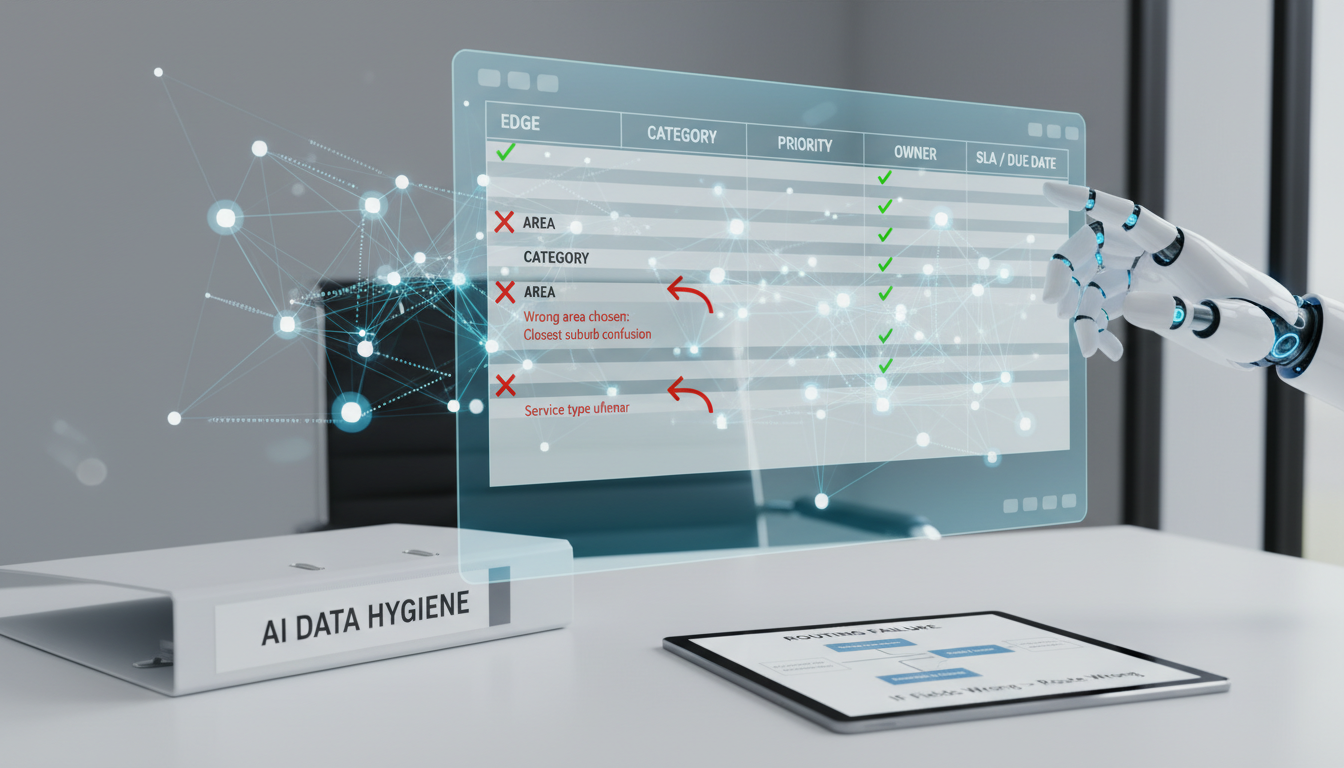
AI assistant data hygiene is the set of rules and checks that keep the data your AI uses clean, current, and complete. It stops duplicates, wrong contact details, messy inbox threads, and broken hand-offs. When data stays clean, an AI assistant can route work correctly, create the right tasks, and take safe actions without adding chaos.
If an AI assistant is making mistakes, the problem is often the data, not the AI. This guide shows a reliable way to fix the inputs so outputs improve.
[IMAGE: Feature image — 1200×630 — Alt text: AI assistant data hygiene workflow showing clean CRM records, inbox triage, and safe automation checks]
Table of Contents
- Why AI assistants fail without data hygiene
- The real-world mess: where bad data comes from in South African businesses
- What “good” looks like: the minimum standard for AI-ready data
- Duplicates: how to prevent them before they happen
- Bad routing: how to keep leads, tickets, and tasks going to the right place
- Wrong actions: how to make AI assistants safe to use
- A simple operating system: roles, checks, and review rhythm
- Implementation blueprint: set up data hygiene in 14 days
- Key takeaways
- Conclusion: cleaner data = calmer days
Why AI assistants fail without data hygiene
AI assistants are fast. They reply, route, summarise, and create tasks in seconds. But they also follow what the data tells them.
When data is messy, AI assistants can:
- Send replies to the wrong person
- Log a lead twice and split the history
- Create tasks with missing details
- Route work to the wrong team member
- Update the wrong record
- Summarise the wrong thread
The hidden cost of “close enough”
Bad data does not only cause small errors. It creates:
- Slow follow-ups (leads go cold)
- More manual admin (people fix mistakes)
- Less trust (teams stop using the system)
- Worse reporting (bad decisions)
- Owner burnout (constant firefighting)
In the Business automation [Techanisms] world, the goal is calm, repeatable systems. Data hygiene is the base layer.
What this post is for
This is a master template Blog Engine 2 [Test] can adapt for Pretoria and . It is built for:
- Internal AI assistants
- AI inbox summarisation
- AI task triage
- AI document handling
- AI knowledge support
It focuses on structure and reliability, not gimmicks.
The real-world mess: where bad data comes from in South African businesses
In many South African teams, data problems come from normal daily work. Not from “bad staff”.
Common causes include:
- One person uses email, another uses WhatsApp, another uses calls
- Leads come from forms, ads, referrals, and walk-ins
- Names and company names are typed in different ways
- People paste data from PDFs and screenshots
- A CRM is used “sometimes”
- An inbox has shared threads and forwards
Typical problem spots (where AI assistants get confused)
- CRM contacts and companies: duplicates and missing fields
- Shared inboxes: long threads, unclear owner
- Helpdesk tickets: wrong category and priority
- Job cards and scheduling: unclear site address, missing access notes
- Finance hand-offs: missing VAT details, mismatched customer names
Why it gets worse once AI is added
AI assistants increase speed. That is good.
But speed makes small data errors spread faster:
- A duplicate record becomes five duplicates
- A wrong tag routes work all day
- A bad template sends the wrong message to many people
So the first win is not “more automation”. The first win is better inputs.
What “good” looks like: the minimum standard for AI-ready data
Data hygiene does not mean perfect data. It means data that is reliable enough for safe actions.
The AI-ready minimum standard
A simple target most businesses can reach:
- One record per real person or business
- Clear owner (who is responsible)
- Clear status (where they are in the process)
- Required fields filled in (only what matters)
- Consistent labels (tags, categories, reasons)
- Timestamped notes (so summaries are accurate)
Define “source of truth” (no guessing)
Every key item needs one home.
Decide:
- Where contacts live (CRM)
- Where conversations live (inbox/helpdesk)
- Where tasks live (task tool)
- Where documents live (drive)
Then make it a rule:
- If it is not in the source of truth, it does not exist.
Choose your “golden fields”
Golden fields are the small set that drives routing, reporting, and actions.
Examples:
- Full name
- Mobile number
- Company name
- Area/suburb
- Service type
- Stage/status
- Owner
- Consent/opt-in status
Keep it short. Too many required fields causes skipped fields.
Make the fields easy for South African data
Keep formats clear:
- Mobile numbers: one format rule
- Suburbs and areas: consistent spelling
- Addresses: street, suburb, city, province
- Company names: one main name, not many versions
Duplicates: how to prevent them before they happen
Duplicates are the fastest way to break an AI assistant.
They split the story:
- The AI sees two records and picks the wrong one
- A sales rep calls the same person twice
- Reporting counts one lead as two
Why duplicates happen
Common patterns:
- A person fills in a form twice
- A staff member saves a new contact instead of searching
- The same person uses two email addresses
- WhatsApp numbers are saved with different formats
The simple duplicate prevention stack
Use layers. Each layer catches a different problem.
1) Standardise input at the door
- Use form rules (required fields, validation)
- Use drop-downs for service type and area
- Avoid free text where it causes chaos
2) Match before create
Before a new record is created, check:
- Mobile number
- Company name + domain
Rule:
- If a match is likely, update the existing record.
3) Use a “merge queue”
Not every duplicate can be auto-merged. Some need a human.
Set a simple process:
- Suspected duplicates go into a queue
- Someone reviews them daily or weekly
- Merges are logged
4) Give the AI a safe rule for duplicates
If the AI is unsure, it must not guess.
Safe behaviour:
- Create a task called “Possible duplicate: review”
- Attach both records
- Stop any outbound message until confirmed
H3: What to tell the team (so it sticks)
A short rule set helps:
- Search first
- Update the record, do not create a new one
- If unsure, flag it
This reduces fights and blame.
Bad routing: how to keep leads, tickets, and tasks going to the right place
Bad routing wastes time and kills trust.
In automation, routing usually depends on:
- Stage
- Category
- Area
- Priority
- Owner
- SLA or due date
If these fields are wrong, AI will route wrong.
Common routing failures
- Wrong area chosen (closest suburb confusion)
- Service type is unclear, so it goes to the wrong team
- Everything is marked urgent
- No owner is set, so it sits in a queue
Build a routing map that is simple

Start with a small number of paths. Then expand.
Example routing rules:
- If area is in , assign to that branch team
- If service type is “Emergency”, set priority high
- If it is “Quote request”, assign to sales
- If it is “Existing customer issue”, assign to support
Use “routing labels” the AI can handle
Keep labels:
- Short
- Clear
- Not overlapping
Avoid having:
- “Support”, “Customer Support”, “Help”, “Assistance”
Pick one label and enforce it.
Add guardrails for high-risk routes
Some routes have bigger impact.
Guardrails:
- For cancellations: AI drafts only, human sends
- For complaints: AI summarises and routes, human responds
- For finance issues: AI requests missing info, but does not change amounts
H3: Make routing visible
Teams follow what they can see.
Add:
- A simple “Why this was routed” note
- The fields the AI used
This builds trust fast.
Wrong actions: how to make AI assistants safe to use
Wrong actions are the most damaging. They include:
- Sending the wrong message
- Updating the wrong record
- Closing a ticket too early
- Booking a time with missing info
Use action levels (Draft, Assist, Act)
A safe model:
- Draft: AI writes, human sends
- Assist: AI updates low-risk fields, human reviews
- Act: AI takes action on strict rules
Do not start with Act. Earn it.
Define “never do” actions
Every business needs a short list.
Examples:
- Never delete records
- Never change a customer’s legal name
- Never confirm a booking without required details
- Never mark a payment as received
Add “stop checks” before action
Stop checks are quick rules.
Examples:
- If the contact has no mobile or email, do not send
- If the task has no due date, do not assign
- If there are two possible matches, do not update
- If the message contains certain keywords, route to a person
H3: Keep an audit trail
If something goes wrong, the team must see what happened.
Minimum audit trail:
- What the AI saw
- What it decided
- What it changed
- Who approved it (if needed)
This reduces fear and speeds up fixes.
A simple operating system: roles, checks, and review rhythm
Data hygiene is not a once-off clean-up. It is a habit.
Assign ownership (so it does not die)
Clear roles:
- Data owner: sets rules
- System admin: manages fields and permissions
- Team leads: enforce use
- Users: follow the process
Even in small teams, name the owner.
Set a review rhythm
Simple and realistic works best:
- Daily: duplicate queue check
- Weekly: routing error review
- Monthly: field usage and drop-down cleanup
Track a small set of health metrics
Keep metrics easy.
Examples:
- % of records missing golden fields
- Duplicate rate (new duplicates per week)
- Wrong-route count
- Time to first response
These connect data hygiene to revenue and calmer ops.
H3: Train with examples from real work
Use local examples:
- A lead from Pretoria with two numbers
- A company with two names
- A suburb spelled three ways
People learn faster when it matches their day.
Implementation blueprint: set up data hygiene in 14 days
This is a practical plan Blog Engine 2 [Test] can run with clients.
Days 1–2: Map the system
- List tools in use (CRM, inbox, helpdesk, task tool)
- Pick the source of truth for each
- List the golden fields
Deliverable:
- One-page map and field list
Days 3–5: Clean the biggest mess first
Pick one dataset:
- Contacts
- Companies
- Tickets
Steps:
- Export if needed
- Remove obvious duplicates
- Standardise formats
- Fill missing golden fields where possible
Rule:
- Fix the top 20% that causes 80% of pain
Days 6–8: Build input rules
- Form validation
- Drop-down lists
- Required fields (only key ones)
- Naming rules for notes
Deliverable:
- Clear input standards and simple training note
Days 9–11: Add AI assistant guardrails
- Choose action levels (Draft/Assist/Act)
- Add stop checks
- Add audit trail logging
Deliverable:
- A safe workflow that the team trusts
Days 12–14: Monitor, tune, and lock it in
- Review routing errors
- Review duplicate queue
- Adjust labels and rules
- Set the weekly review slot
Deliverable:
- A working rhythm that keeps data clean
H3: When to call for help
If any of these are true, support helps:
- Multiple tools with no clear owner
- Teams are fighting the system
- Reports do not match reality
- The AI assistant is making repeated mistakes
This is where Blog Engine 2 [Test] can step in with an AI-powered business automation setup that is reliable.
Key takeaways
- AI assistant data hygiene is the foundation for safe automation.
- Clean inputs stop duplicates, bad routing, and wrong actions.
- Pick a source of truth and a small set of golden fields.
- Use layers to prevent duplicates, not just clean-ups.
- Start AI actions in Draft mode, then earn more autonomy.
- Ownership and a review rhythm keep the system healthy.
Conclusion: cleaner data = calmer days
AI assistants can reduce admin, speed up response times, and cut chaos. But only if the data they use is trustworthy.
The best approach is simple: set a minimum standard, stop duplicates at the door, make routing rules clear, and put safety checks around actions. When the team sees fewer mistakes, they use the system more. That creates cleaner data again. It becomes a good loop.
Want Blog Engine 2 [Test] to help set up AI assistant data hygiene and safe AI assistants for your business in Pretoria and ? Call +27 12 345 6789 or email info@example.com to book a quick assessment and get a clear next-step plan.
Leave a Reply